Wild West: Farm Town Simulator
- 4.1
- Rating
- 10.00M
- Installs
- Free
- Price

 Analysis by App-foxy
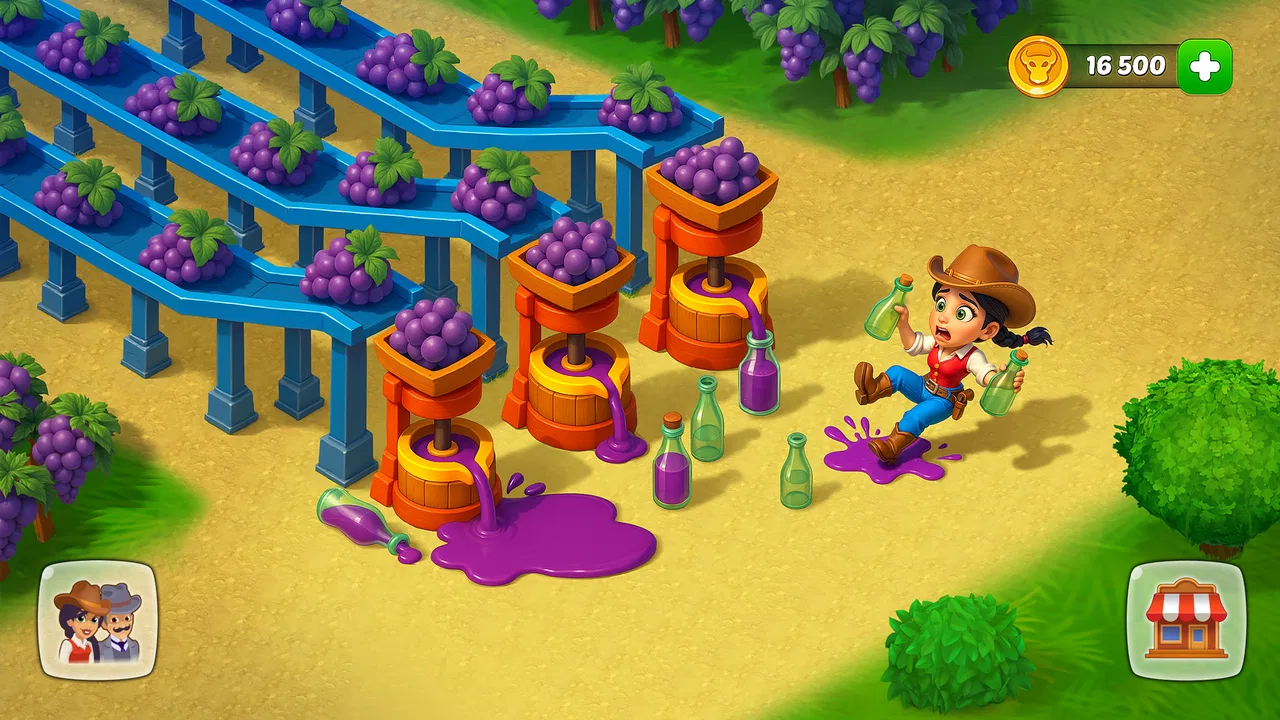
I spent time with Wild West: Farm Town Simulator as a relaxed farming game with a western setting, and its main appeal became clear quickly: it turns routine farm work into a steady loop of planting, collecting, producing, and expanding. The game is published by Social Quantum Ltd and is free to start, so it is easy to try without committing money upfront. What kept me playing was not a dramatic story, but the satisfaction of making a small ranch more useful one practical decision at a time.
This is a simulation game for people who enjoy gradual progress rather than instant rewards. You begin with a modest piece of land and work toward a busier farm, while the Wild West presentation gives familiar agricultural tasks a warmer personality. The store describes it as a path from a small ranch to a respected farm, but in practice I found the experience more personal than grand: the fun comes from arranging your routine, deciding what deserves attention first, and watching the settlement become more productive.
How the daily farm routine actually feels
The basic workflow is easy to understand. I check what is ready, collect available goods, start the next useful production task, and then spend any remaining time improving the farm or preparing for the next return. That order matters more than it first appears. If I start by decorating or expanding without checking production, I can leave valuable work idle. If I collect everything without considering what I will need next, I may have plenty of materials but nothing useful running.
You May Also Like

 Blood Strike: 2.5 Anniversary
Blood Strike’s Loadouts Turn Every Drop Into a Tactical Gamble
A close look at Blood Strike’s custom loadouts: how fast access to signature weapons reshapes its battle royale rhythm, rewards preparation, and narrows the gap between fights.

 Pandora - Music & Podcasts
Pandora’s Music Is Easy to Start, but Harder to Recover
Pandora’s strength is its low-effort path from a seed to a station. Its weak spot is how much confidence it asks you to place in connection, setup, and quiet recovery.

 8 Ball Pool
 Is Built on Rivalries, Rematches, and Routine
A close look at the rivalries, rematches, shared routines, and unanswered safety questions that turn a quick pool match into a persistent mobile community.

 Samsung Music
’s Quiet Strength Is Playing What You Already Own
Its reach comes less from spectacle than from dependable access to a personal library. That simplicity is both the app’s strongest retention engine and its ceiling.

 AccuWeather: Weather Radar
AccuWeather Review: A Quick, Clear Forecast for Everyday Decisions
For everyday plans, the best forecast is the one you can understand quickly. AccuWeather makes rain timing, radar, and local conditions easy to act on, with a few trade-offs.

 Hill Climb Racing
Why Hill Climb Racing Still Turns Crashes Into One More Run
A tiny car, a bumpy hill and one more upgrade: Hill Climb Racing keeps resurfacing because its simple chaos makes every near-miss feel personal.
More From Our News Desk
View All News


My preferred routine is to begin with the longest tasks I can reasonably complete before leaving the game. When I expect to be away for a while, I start those tasks first. When I know I will return soon, I choose shorter activities so the farm is not sitting inactive. This sounds simple, but it is one of the most useful habits in a timer-based farming game. The goal is not to tap as quickly as possible; it is to reduce empty time between production cycles.
The western theme helps the game avoid feeling like a plain spreadsheet with crops. Buildings, land, and the general presentation make the farm feel like a developing frontier community. Still, the underlying rhythm remains familiar to anyone who has played a mobile farming simulator: gather resources, convert them into more valuable goods, complete requests, and reinvest the results. Players looking for action or a deep narrative should know that the atmosphere is more important than combat or plot.
I also recommend deciding what kind of session you want before opening the game. A short visit works well for collecting finished goods and starting a few new tasks. A longer session is better for reorganizing the farm, checking available objectives, and making several production decisions in sequence. Treating every visit as a major building session can make progress feel slower, while treating every visit as a quick claim-and-leave session means you may miss the planning that gives the game its depth.
What to do when you only have a few minutes
For a quick everyday session, I use a three-step check. First, I collect anything that has finished. Second, I restart the most useful production instead of choosing randomly. Third, I look at the next likely bottleneck. If I keep running out of one basic material, producing more of something else will not solve the problem, even if that other item seems more valuable.
This makes the game suitable for small breaks during the day. For example, I can open it while waiting for an appointment, collect completed work, queue a task that will run while I am busy, and close it without feeling that I need to finish a long level. The trade-off is that progress depends on returning at sensible intervals. If you dislike games that reward routine check-ins, the central design may feel repetitive rather than relaxing.
One practical tip is to avoid filling every available production space automatically. Leaving a slot open can be useful when you know a particular item will soon become important. I found that a farm with a little flexibility was easier to manage than one where every space was constantly occupied by whatever happened to be available. This is especially helpful when an objective or request suddenly changes what you need.
Settings and habits that make the experience smoother
The most important settings check is not a hidden performance trick; it is making sure the game fits the way you plan to play. I look at notification controls and decide whether reminders are helpful or distracting. A farming game can become annoying if every completed task interrupts the day, but completely disabling reminders may cause long stretches of unused production time. I prefer selective, quiet reminders when the device allows that level of control.
I also check sound and music early. The western atmosphere benefits from audio when I am playing at home, but I usually lower or disable it in public. This does not change the farm itself, yet it affects whether the game feels pleasant during short sessions. If the game appears visually busy on a smaller screen, reducing distractions elsewhere on the device can make taps and menus easier to follow.
Because the game supports devices running Android 7.0 or later, it is accessible on a broad range of Android hardware. That does not mean every phone will feel identical. On an older device, I would avoid keeping many other demanding apps active and would give the game a moment to settle after opening it. I would also keep enough free storage available for normal app updates rather than waiting until the device is nearly full.
The current version is 57.4, so I would keep automatic updates in mind if the game is part of a regular routine. Updating is usually sensible for compatibility, but I prefer not to update immediately before an important travel day or a period when I expect unreliable connectivity. That is not a criticism of this particular title; it is a practical habit for any game built around returning to an ongoing farm.
There is another setting-related decision that affects enjoyment: how much money you are willing to spend. The game is free, but its in-app purchases range from $0.49 to $99.99 per item. I recommend deciding on a personal limit before a shortage or slow timer creates pressure. The game is easier to enjoy when purchases are treated as optional convenience rather than part of the normal farming budget.
Faster progress comes from planning, not frantic tapping
Experienced play is mostly about recognizing repeatable patterns. I group my decisions into three categories: immediate needs, near-term needs, and long-term improvements. Immediate needs keep the current cycle moving. Near-term needs prepare the next few tasks. Long-term improvements make future sessions easier. Mixing all three without a plan can leave the farm busy but inefficient.
A useful pattern is to connect collection directly to production. When I gather a basic resource, I ask where it should go before starting another task. This prevents the common mistake of producing something simply because the option is available. The best choice depends on what I expect to need next, how long I will be away, and whether I am trying to complete a particular request.
I also try to keep one short task available for the end of a session. If I am about to close the game and all production choices take a long time, the farm may be poorly aligned with my next visit. A short task can be useful when I know I will return soon, while a longer one is better overnight or during work and school hours. Matching task duration to real life is one of the clearest ways to improve progress without spending.
Another advanced habit is to separate expansion from decoration. A more attractive farm is enjoyable, but decorative choices do not always solve the next practical problem. I first make sure the farm can support the production and storage decisions I am already making. Once the routine feels stable, I add visual changes. This approach may sound less creative, but it prevents the frustration of making the ranch look better while leaving its useful workflow awkward.
Requests and objectives deserve a similar approach. I do not chase every available goal immediately. Instead, I focus on goals that fit what the farm is already producing. If a task requires a long chain of preparation, I compare its eventual benefit with the effort and time involved. This keeps the game from turning into a constant scramble between unrelated demands.
For players who spend nothing, patience is the main resource. I would rather maintain a reliable production rhythm than repeatedly interrupt it with rushed decisions. Small, consistent improvements add up, and the free structure gives the game a comfortable low-pressure entry point. The downside is obvious: players who want rapid expansion may find the normal pace too slow and may be tempted by paid options.
Where the simulation becomes demanding
The main limitation is repetition. The core loop is pleasant at first because each collection feels like visible progress. Over time, the same rhythm can become routine, especially if you prefer games with constantly changing challenges. The western setting gives the process character, but it does not remove the underlying reliance on waiting, collecting, and planning.
Another limitation is the tension between available space and useful space. A growing farm can become harder to read when buildings, decorations, and production points compete for attention. I found that leaving clear paths and grouping related elements made the layout easier to understand. A tidy arrangement is not only cosmetic; it reduces the time spent searching for the next interaction.
The game is also not ideal for someone who wants a fully hands-off experience. Returning at the right time improves efficiency, and ignoring the farm for long periods can make the progress loop feel sluggish. On the other hand, it is a poor match for someone seeking a fast competitive game where every session is about reflexes or direct player-versus-player pressure. Its strengths are patience, organization, and gradual development.
The age rating is Everyone, which matches the approachable tone and makes it suitable for a broad audience. Even so, younger players may need guidance around in-app purchases, particularly because the highest-priced option is much larger than the small introductory purchase. I would enable device-level purchase protections and agree on a spending rule before handing the game to a child.
Compared with simpler farming games, this one benefits from its Wild West identity and a stronger sense of building a frontier settlement. Compared with more complex management simulators, it is easier to pick up and less demanding to understand, but it also offers fewer reasons to expect a deeply technical economic model. I would choose it over a purely decorative farm game when I want planning to matter, but I would choose a heavier management title when I want detailed logistics, complex markets, or a more serious challenge.
Who should install it and who should skip it
I think the game is a good fit for players who enjoy checking a project several times a day, making small improvements, and seeing a familiar place gradually change. It works particularly well for someone who likes the idea of a farm but does not want a demanding action game. The free entry point makes it easy to test the rhythm and decide whether the waiting and production cycles feel satisfying.
I would recommend skipping it if you need constant novelty, dislike timers, or feel uncomfortable with optional purchases appearing in a free game. It is also not the right choice if your main goal is a realistic agricultural simulation. The presentation is stylized and game-like, with the Wild West used to shape the mood rather than recreate every detail of ranch management.
With over 10 million installs and an average rating of 4.1 from around 132 thousand ratings, it has clearly attracted a substantial audience. Those figures suggest a well-established mobile game, but they do not guarantee that its pace will suit everyone. My own recommendation is to judge it after several ordinary sessions, not just the opening minutes. The early expansion is appealing; the real question is whether the repeating routine remains enjoyable once the initial discovery fades.
My verdict after settling into the routine
Wild West: Farm Town Simulator works best when I treat it as a gentle planning game rather than a race. Its strongest feature is the way small choices connect: when I start production, what I leave ready for the next visit, how I arrange the farm, and whether I spend resources now or save them for a more useful improvement. Those decisions are modest, but together they create a satisfying sense of ownership.
I appreciate that I can play it in short visits while still having room for more thoughtful sessions. The western atmosphere gives the familiar farming formula a recognizable identity, and the Everyone rating makes it approachable. At the same time, the game asks for patience, and the optional purchases mean I would set boundaries before playing heavily. The routine can also become repetitive if I am looking for constant surprises.
My final advice is to begin with a simple rule: keep production aligned with your next real need, match task lengths to your schedule, and resist expanding faster than your farm can support. If that sounds satisfying, this simulation is worth trying. If it sounds like maintenance work, another type of game will probably serve you better. For me, the best part is not reaching a single grand finish; it is returning to a ranch that is a little more organized and productive because of the choices I made last time.
FAQs for Wild West: Farm Town Simulator
01What is Wild West: Farm Town Simulator about?
Wild West: Farm Town Simulator combines farming, town building, and frontier adventure in a Western-themed setting. You begin with a small settlement and gradually expand it by planting crops, raising animals, producing goods, completing tasks, and improving buildings. The game is designed for casual play, with a mix of resource management, exploration, and light story-driven activities.
02Can I play Wild West: Farm Town Simulator offline?
Some farming and town-management activities may be available without a constant internet connection, but the exact offline functionality can depend on the game version and device. Features such as advertisements, cloud saves, events, leaderboards, or purchases may require internet access. It is best to launch the game online at least once and check which features remain available when your connection is disabled.
03Is Wild West: Farm Town Simulator free to download and play?
The game is generally offered as a free download, allowing you to start farming and developing your Western town without paying upfront. However, it may include optional in-app purchases for currency, resources, boosters, or faster construction. Advertisements can also appear during gameplay. You can usually progress without spending money, although patience may be needed as timers and resource requirements increase.
04What can I do in the game besides growing crops?
Farming is only one part of the experience. You can care for animals, collect materials, manufacture products, upgrade buildings, decorate your settlement, and complete missions connected to the Wild West theme. Depending on the available version, exploration and character-based tasks may also provide additional objectives. These systems give the game more variety than a simple planting-and-harvesting simulator.
05Is Wild West: Farm Town Simulator suitable for children?
The game is generally approachable for players who enjoy colorful, casual management games, and its controls are usually simple enough for younger audiences. Nevertheless, parents should review the store rating, advertising content, privacy information, and in-app purchase settings before allowing children to play. Progression systems, optional purchases, and online features can vary between versions and should be checked on the download page.
Pros
- Relaxing farming gameplay with a charming Wild West setting.
- Simple controls make it accessible for casual players.
- A variety of crops
- animals
- and buildings keeps progress engaging.
- Town-building elements add more variety than farming alone.
- Works well for short play sessions throughout the day.
Cons
- Progress can become repetitive after the initial exploration.
- Some upgrades may require considerable time or resources.
- The Wild West theme is mostly cosmetic rather than deeply developed.
- Limited challenge may disappoint players seeking strategic gameplay.
- Optional purchases can speed up progress and affect the game balance.

Wild West: Farm Town Simulator
Gallery